BDSM: The Soul Made Manifest with Dr Douglas Thomas | 01
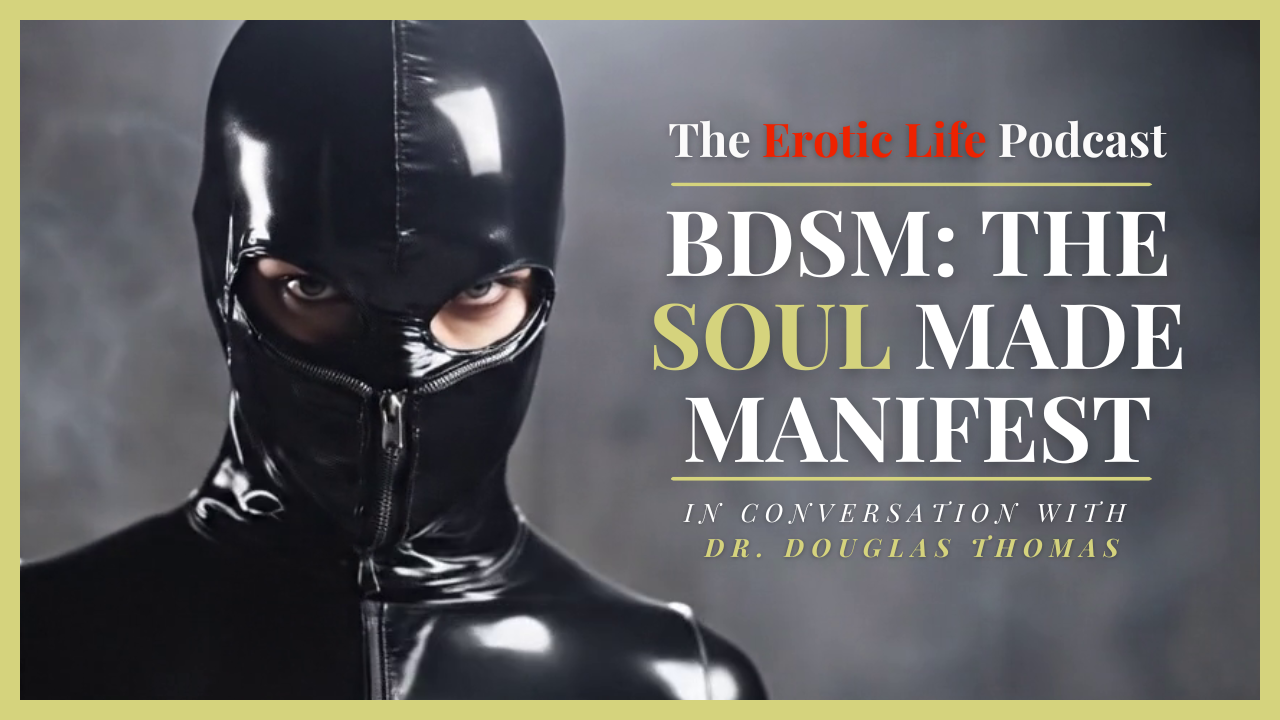
Welcome to this episode featuring Dr. Douglas Thomas, author of The Deep Psychology of BDSM and Kink. If you want to understand the psychological forces at work in human sexuality, this conversation offers a clear framework. For a long time, the medical community labelled kink as a defect or a problem to fix. Dr. Thomas provides a different perspective. He suggests that BDSM creates a safe, consensual container for the soul to express parts of the human experience that society usually forces you to hide. You will hear how psychological views on kink have evolved and why people seek out extreme sensations to find connection, liberation, and love.
Key Points
The history of pathologising kink: In the late 1800s, courts and doctors classified BDSM acts as perversions. Therapists historically literalised these scenes, viewing them as genuine desires to cause harm rather than consensual play.
Freud and normal human impulses: Sigmund Freud argued that enjoying sexual energy outside of procreation is entirely normal. We all carry these aggressive and sexual impulses, and acknowledging them is part of becoming a healthy person.
Deliteralising the act: You must separate consensual BDSM from actual abuse. A dominant tying up a submissive is a metaphorical, theatrical act. It is a safe way to play with power dynamics and surf intense physical sensations.
The soul-centred view: The soul often seeks expression through breakdown, intensity, and submission. BDSM provides a space where the soul can act out these raw elements safely.
The freedom of losing your identity: Wearing a gimp suit or engaging in heavy submissive play removes your daily identity and the exhausting need to make choices. Stripping away your human character allows you to experience a deep, relieving surrender.
Archetypes take over: When you step into a scene, you do not just play a role. The archetype uses you. A dominant or submissive persona is a hidden part of your psyche that demands a safe space to emerge.
Mutual surrender and trust: Both partners must drop their ego defences to participate. The dominant lets go of societal rules against aggression, and the submissive offers complete trust. This mutual vulnerability builds an intense, loving connection.
Timestamps
00:00 Introduction and Context of BDSM
04:51 Dr Douglas Thomas and the book
11:30 Setting the Stage Historical Perspective
13:24 BDSM Approached Through a Historical Lens
13:42 Ancient Romans
16:19 BDSM from 1880s to 1950s
18:52 BDSM Culture After WW2
21:04 Pathologisation
23:23 Freud on BDSM Person-Centerd Approach
28:02 Approaching BDSM Through The Person-Centred Lens
29:05 Literalisation vs Deliteralisation
31:23 Lesbian Effort to Depathologise BDSM
33:09 Physiology Soul-Centered Approach
37:37 Approaching BDSM Through the Soul-Centred Lens
38:05 Defining 'Soul'
43:14 The Soul in BDSM
46:48 Image-Focus
51:09 Play as an Integrative System
53:48 Stripping and Nakedness
58:04 The Soul-Centred Core
01:02:34 The Suffering Soul
01:08:27 Destruction of Self
01:11:25 Humiliation, Degradation, and Dehumanising
01:14:24 Freedom and Transformation
01:19:39 The Final Word Is Love
Transcript:
Please note: This transcript has been corrected using AI since the original software does not do a great job. There may be small errors.
Sergio Rebelo (02:20)
Dr. Douglas Thomas, it is fantastic to have you on the show. Thank you for being here.
Douglas Thomas (02:25)
Thank you, it is a pleasure to be here.
Sergio Rebelo (02:28)
Great. And also just before recording everyone, Douglas told me that it is the season of peacocks. Is that right? Where you are at?
Douglas Thomas (02:35)
That is correct. For anybody that knows the foothills of the San Gabriel Mountains near Los Angeles, peacocks have become this addition to the landscape over the last couple of hundred years and they are doing quite well in this environment. It is springtime, so we are probably going to hear them doing their thing outside.
Sergio Rebelo (02:56)
Yes, it is our third guest. They are part of the conversation. They are going to check in with us. That is absolutely fine. I emailed you in December because I was incredibly excited about your book, The Deep Psychology of BDSM and Kink. It is a fantastic contribution to the scene and to BDSM in general. I came across that book about two years ago. It came out in 2024, I think.
It popped up on my screen and I thought about where this came from. It instantly spoke to me. I thought this is very important. The reason I think it spoke to me was because any time that I participate in BDSM, something important is happening. I never understood what was going on. In my own reflectivity and speculation, I thought archetypes were at play.
There was an archetypal energy which brought myself into the scene and the other person. That is as far as I could go. I could just be taking on an archetype. Then your book came out and I opened it up. I started to read it and I thought I need to put this down because this guy really takes this seriously and I need to take this seriously as well. I am going to find the right time and the right place to engage with it in that way. I read through it very slowly, chunk by chunk.
I wanted to grasp what it offers us regarding a new layer and a new perspective on what could be happening alongside other things in the act of BDSM. I want to say thank you for that contribution because it finally put language to an experience I was having and I did not know what was going on. Thank you.
Douglas Thomas (04:46)
I am delighted that it spoke to you on that level. That is very gratifying.
Sergio Rebelo (04:49)
Yes. I think it may be helpful for you to give a brief description to the listeners of who you are and how this book came into being.
Douglas Thomas (05:01)
I got my master's in social work back in the 90s and worked in community mental health for probably the first decade of my career. I felt like there was something seriously missing that was not speaking to me on a deeper level of passion or excitement working as a psychotherapist.
I discovered Jungian psychology and depth psychology through Pacifica Graduate Institute. I attended and got my PhD. One of the things that is very important to the tradition of depth psychology, beginning with Freud, is looking at the unconscious as the primary factor for determining what is guiding our thoughts, our feelings, our wishes, and our desires.
Sergio Rebelo (06:00)
Yes.
Douglas Thomas (06:01)
One of the things about Freud and Jung following him was that they were pioneers of an incredibly subversive tradition. To have women with these neurotic disorders coming in and lying down on the couch and free associating and speaking about their sexuality and their sexual fantasies was something extremely taboo for the time.
Sergio Rebelo (06:22)
Okay.
Douglas Thomas (06:27)
One of my mentors and one of the great thinkers who influenced my own work, James Hillman, would remind us periodically that we come from a subversive profession and we really should never forget that. Psychology should be provocative. It should look at aspects of the culture that had been unexamined.
Sergio Rebelo (06:36)
Okay.
Douglas Thomas (06:53)
Unexplored, neglected, marginalised, pushed to the side, and the periphery, because that is where the unconscious is. It is not only the unconscious, but they also call it the soul, the psyche, and the soul. If you look in the German in the collected works of Jung and Freud, they will use the word seele, which means soul, as often as they use the word psyche.
Sergio Rebelo (07:05)
Hmm.
Douglas Thomas (07:17)
It is a soul psychology and the place where the soul resides is in these pockets and marginalised spaces. I am an openly gay man.
Sergio Rebelo (07:27)
Hmm.
Douglas Thomas (07:28)
Part of my sexual experience involved familiarity. I would not say that it was intense, but I would say it was close familiarity with the BDSM and leather community as part of the gay community.
Sergio Rebelo (07:38)
Okay.
Douglas Thomas (07:45)
I recognised that this was a highly marginalised group that was misunderstood by people outside that group. Something extremely powerful, significant, and meaningful was happening for people through their sexual encounters. It was about something that was much more than having sex. It struck me this is a topic that psychology has been neglecting.
Sergio Rebelo (08:05)
Yes.
Douglas Thomas (08:13)
Partly out of modesty and there is something very important happening here. That was my motivation to write the book.
Sergio Rebelo (08:23)
Was it quite a long process to get this book in shape because you do go into a lot of depth? This is one thing which particularly struck me.
Douglas Thomas (08:32)
It took about five years to write the book. I am just thinking back now about that process. There was something about it from the beginning that crystallised. I could really see the whole book from the beginning and I could see what I wanted to say. Fleshing it out as it went along carried a risk of topics creeping and broadening out. At some point you have to decide how you are going to rein this in and create something coherent. I was concerned about creating something easy to understand for lay readers and at the same time challenging and enriching for clinicians. One of the things about the BDSM community that we have seen consistently in research is that they have negative experiences in psychotherapy. They come in to work with a psychotherapist because they are having some issue with anxiety or depression. Pretty soon the therapist finds out about their sexuality and says we have to address this in therapy.
Sergio Rebelo (09:40)
Okay.
Douglas Thomas (09:58)
They have no need to address their sadomasochism. That is not the issue bringing them in. They feel like the work they wanted to do has been hijacked by the therapist foregrounding that because the therapist is uncomfortable with it. I felt it was important to make a contribution to my field to give clinicians another point of view. They could look at this transgressive sexuality or radical alternative sexuality with a positive point of view that something valuable is happening. There is nothing that needs to be fixed.
Sergio Rebelo (10:40)
Yes. I get this often in my practice because I focus on kink and BDSM. That is my niche. I get clients who come in and say they have been with a therapist and it has been great, but they have never disclosed their sexual interests. They will tell me that in the first or second session. I think you have been with a therapist for a number of years and obviously there has been benefit there, but you have withheld this and there is a reason for that. I completely connect with what you are saying regarding a culture which has not caught up yet with the kink or BDSM truth that many people live.
Douglas Thomas (11:28)
That is exactly right.
Sergio Rebelo (11:30)
Let us get into your book. I want to take it step by step. A good way of approaching it is if we first go through the historical context of BDSM to understand how history sees it. Then we move into how we see it now as therapists who are well versed and have experience. After that, we can go into the deeper layer which your book discusses. I want to offer a small BDSM scene that I wrote up as an anchor point which we may come back to. I just want to return to a point of asking what history would see this scene like and what we would see it as now. One partner is tying up the other. The master is in a uniform, perhaps leather or military. The submissive slave is naked or in a gimp suit and they are bound up by rope. There is dark lighting and maybe some candles around. It is a very simple scene.
Douglas Thomas (13:22)
Okay.
Sergio Rebelo (13:28)
If people from history were to look through a window and see people participating in that, how would they feel towards that and why?
Douglas Thomas (13:41)
It depends how far back you want to go in our time machine. We do know about ancient Rome.
Sergio Rebelo (13:48)
Wow. Okay. I was thinking a hundred years. Let us go to Rome.
Douglas Thomas (13:57)
I am just going to pick something. In Pompeii, they excavated a villa known as the Villa of Mysteries.
Sergio Rebelo (14:20)
Yes.
Douglas Thomas (14:29)
There are beautifully preserved frescoes inside that include images of what they believe is an initiation ceremony. It has a naked female initiate on her knees being scorched by a long staff. It is interpreted as the staff of Dionysus. We know that flogging, restraints, and scourging are cross-cultural. They occurred in the ancient world. They have occurred in indigenous cultures like the Lakota Sioux Sundance ceremonies. The Hindu Kavadi ceremony is another. We have these points of reference where people from other times and cultures might look at the scene of a dominant master in a uniform tying up a slave in a gimp suit. They might be puzzled by a gimp suit, but they might recognise with the candles that this is an initiation.
Sergio Rebelo (15:45)
Yes.
Douglas Thomas (15:47)
They would see that something unusual and important is being enacted.
Sergio Rebelo (15:56)
With something valuable. That far back they would see that there is value in this.
Douglas Thomas (16:04)
I do not think they would come home to their families and say you would not believe what people in 2026 are doing. In the ceremony, I think they would have a point of reference. If you go to the 1880s in brothels, whipping and flogging was a popular activity. I believe the original Hellfire Club was in London and considered part of a brothel. The sex workers specialised in flogging and whipping. There is that sense of pairing something erotic and arousing with something that is difficult and potentially painful. It is experimenting with pain that is also blending pleasure so that it becomes confusing for the psyche. We start to see more theatrical enactments brought into these activities in the late 1800s. We also see an increased interest in the psychotherapeutic community to start looking at sexuality and determining if it is healthy or unhealthy.
Sergio Rebelo (17:34)
Yes.
Douglas Thomas (17:56)
That had not been the case before. It was largely the work of the church to determine what was considered appropriate or pure. In the late 1800s, you have this shift. They would start to recognise something about the scene that is a transgressive sadomasochistic enactment. If you jump ahead to another point in time, we know there were gay men in our major metropolitan centres in the 1920s exploring sadomasochism as part of their sexuality. They would recognise it even more if we are imagining a same-sex couple.
After World War II, things really take off. There are different opinions historically. There is truth to one line of thinking that gay men who served in the military had intense experiences in combat with other men. They met other gay men in the military and formed close relationships. When they came back to the States, they did not want to resume the life they had left behind in rural towns. They stayed in the urban centres and some enjoyed participating in motorcycle clubs.
You get this idea from the military of a very strict hierarchy and code of conduct. You see all of these things in BDSM after World War II. The motorcycle clubs would go on rides out into rural areas and rough sex or extreme sex was part of what they would do. The men had to wear leather because that is what you wear on a motorcycle to protect yourself from the wind and the heat.
Sergio Rebelo (20:18)
Hmm.
Douglas Thomas (20:40)
Then the biker bars and leather bars started serving a gay clientele. You have a whole culture that develops around leather and bikes. I think in the 1950s, people would look at that scene and say the rest of it looks perfectly familiar.
Sergio Rebelo (20:58)
Yes. There is a culture that builds with these rituals and attire building underground because there is a shift that seems to happen from the 1850s where the act feels much more pathologised. It is wrong. The word that caught my attention in the book was that people would literalise this scene. They would not see the poetics of it or the metaphor. Therapists back then would literalise and then pathologise.
Douglas Thomas (21:32)
Absolutely. It is very much this notion in the late 1800s and particularly with Richard von Krafft-Ebing and his Psychopathia Sexualis. It is an encyclopedia of what he would consider to be deviant sexuality. That was a point of interest primarily for the courts and for the legal profession because cases would come forward involving strange sexual behaviour. The courts had to determine if this perversion was illegal. They would bring in the mental health experts. The whole orientation towards sexuality was whether it was healthy or unhealthy.
Sergio Rebelo (22:17)
Yes.
Douglas Thomas (22:35)
Was it abiding by some moral standards of society or transgressing those standards? You got it exactly right.
Sergio Rebelo (22:41)
Yes. I think that carries on even in today's world. Clients come in and present something they are interested in and they think it needs to be fixed or it means they are wrong. They carry this echo of literalising what they fantasise about. That is the aftermath of an entrenched attitude towards these practices.
Douglas Thomas (23:11)
Here is the linchpin that I think is so important and fascinating. Freud gets a bad rap in so many circles culturally and in the therapeutic community today. What Freud brought in is a direct response and a word of reassurance to the client who comes in today and says they were degraded and treated like an object and they loved it. Freud would say you like it so much because it is normal.
Sergio Rebelo (24:02)
Yes.
Douglas Thomas (24:07)
It is not pathological. It is not some subgroup of the population who is deviant and perverted. We are all deviant and perverted. We all carry within us what he called polymorphous perversion. It sounds horrible. It is a very unfortunate term.
Sergio Rebelo (24:15)
Wow.
Douglas Thomas (24:34)
What he is saying is that we all enjoy these experiences of sexual energy moving through us that have a purpose other than procreation. In the 1800s, that was the gold standard. The idea of perversion is that there is something wrong with me if I enjoy things beyond the fringe of what decent people would be doing. Freud's point is that none of us are normal or decent. It was groundbreaking for him to say this is not a deviant subgroup. We all carry these impulses and fantasies and the work of becoming healthy is to recognise it and adjust to the fact that this is who we really are.
Sergio Rebelo (25:29)
Would that be the id trying to push its way through something like this?
Douglas Thomas (26:05)
Yes. All of these different desires of releasing or discharging of sexual and aggressive impulses is all the work of the id.
Sergio Rebelo (26:21)
So there is this tension. You have different individuals and groups pulling into different directions. Men who are going to leather communities. You have the psychotherapy community coming in. Then there is this law layer where a famous case in England resulted in a group of men participating in BDSM being taken to prison because it was wrong to hurt people.
Douglas Thomas (27:00)
Very important point that it continues to be criminalised. You can have examples today of custody battles where a couple opens up the relationship for BDSM and then the marriage falls apart. They go to court over custody and this is brought in as evidence to determine if they are a fit parent. It is not illegal on the face of things, but it is being treated as a defect in character to determine a legal verdict.
Sergio Rebelo (28:01)
Some parts of the world have not caught up to where other parts are now. I want to move towards this person-centred approach we have now with people who understand what is going on. It is not about a deep aggression genuinely wanting to hurt people. It is not being literalised. Now we can understand it is being deliteralised. Looking at that scene, we can understand an attachment pattern may be going on from younger years. Their personalities are complementing each other. We see it now not as a deviant act.
Douglas Thomas (29:04)
Thank you. You brought up a point I really emphasise in the book. We live within a culture that has a fondness for literalising because it makes things clear. It makes the edges of right and wrong quite sharp. We even see the use of the word literally as an intensifier to intensify excitement. Jung and Freud both really appreciated the importance of a metaphorical basis or a metaphorical frame of mind. James Hillman coined that term. A deliteralised frame of mind means we are not going to say this is literally being enacted by one person upon another.
Sergio Rebelo (30:15)
Yes.
Douglas Thomas (30:29)
Torture is something horrific that has been done throughout history and continues today. It essentially extracts harm non-consensually. When you get into BDSM and kink, it is very important that there be negotiation and consent. It is one of the main factors separating BDSM and kink from activities people call abuse.
Sergio Rebelo (31:02)
Yes.
Douglas Thomas (31:23)
The lesbian sex wars occurred in the 1970s between some feminist thinkers like Susan Sontag, Adrienne Rich, and I might have that wrong, sorry. A group of leather dykes wrote their own journal saying this is voluntary and consensual. They said it is a source of empowerment to name their pleasure and desire without anyone telling them it is misogynistic or abusive. They were working to deliteralise BDSM.
Sergio Rebelo (32:24)
Yes. That is such an important distinction to make. It is this shift from literalising to deliteralising. That is the beginning ground of where we come into the soul-centred approach. We have to exercise the capacity to understand metaphor, symbol, and poetry.
Douglas Thomas (33:00)
Let us add transformation to that list.
Sergio Rebelo (33:06)
Yes. Even with this person-centred approach, we understand these two people are attaching in certain ways. If a neurologist looked at this, they would understand these scenes create flow states. They are experiencing bound pressure and this creates a response in the brain. We really get to understand what is going on internally.
Douglas Thomas (33:49)
We have to do a shout out to my colleague and friend, Brad Sagarin, for the excellent research he has done at BDSM play parties. He took swabs and tested the chemical composition of saliva. He looked at the neurochemistry and found what we refer to as subspace when people get spacey and in a trance state. He found it is a flow state for the dominant similar to the book by [Mihaly] Csikszentmihalyi. The dominant has to be empathically attuned to what is happening for the submissive. The submissive often wants to be taken to the edge of what they can stand into a state Avgi Saketopoulou writes about as overwhelm. We want to experience overwhelm as the payoff for the scene.
Sergio Rebelo (35:38)
I think we forget that we are a species that loves to surf sensations. We get sensations and we like to be in them. It is part of the animal that we are.
Douglas Thomas (35:52)
We get a high that releases endorphins and natural opiates when under extreme pressure or pain. You are working with the internal pharmaceutical company of the body and experiencing a maximal amount of pleasure through it.
Sergio Rebelo (36:22)
I love how we are at a stage now where people can just not think about it too much and just do it because it is fun. It does not have to be criminalised. We do not have to think about it too much.
Douglas Thomas (36:59)
I am really glad you are including this because it needs to be said explicitly. A very large number of people enjoy BDSM without reflecting too deeply on it. They just like the gear and dressing up. That is fine. Go be your best self and have a great time.
Sergio Rebelo (37:31)
Absolutely. We see history pathologise and literalise. Now we see it as an interplay of personalities, attachment, and surfing sensations. Then we have this other offering you have in the book, which is a soul perspective. What do we mean by soul before we get into what it actually is?
Douglas Thomas (38:03)
For the purposes of this conversation, let us imagine soul is a word almost synonymous with psyche and imagination. Let us bring in unconscious as a fourth word. James Hillman promoted the word soul. His concern was that the biologising of the psyche through neuroscientific research risks an essentialist perspective that we are nothing more than chemicals moving around in our brain. There is also the medicalisation of the psychotherapeutic profession. The whole culture is oriented towards the psyche as medicalised. Soul moves us back to the way the Greeks used to think about imagination and the relationship between mind and body. What is larger than the individual? Historically we have referred to this as the soul.
Sergio Rebelo (40:17)
Yes. You have a quote in your book. Hillman endorsed this imprecision when he wrote the soul is a deliberately ambiguous concept resisting all definition. I love that he wanted to stay with the ambiguity and uncertainty.
Douglas Thomas (41:31)
He would say soul is the thing that makes meaning possible. It involves a deepening of experience. It is conveyed in love. It often has a religious expression. It has a special relationship with death and it favours symbolic and metaphorical modes of thought. He would say religion has drawn upon the idea, but the idea is bigger than any use within religion. He would advise against reading textbooks about psychotherapy that use technical jargon. He would bring it down to asking if you have ever met an ego.
Sergio Rebelo (42:29)
Many.
Douglas Thomas (42:53)
We can turn it into an adjective and say people are egotistical, but what is the ego itself? He would say authors and poets have done a much better job of describing the soul than psychotherapists have.
Sergio Rebelo (43:00)
If we have two people in a scene, your book argues that the soul is also present. If we develop a lens to understand it, we can make contact with the soul and enrich our experience. Is that the soul-centred approach?
Douglas Thomas (43:56)
Yes. It is something present which is betwixt and between. That gives credit to another great teacher, Marvin Spiegelman. There is something emerging from inside you that maybe you did not know was there. In order to get through your daily routine, you cannot let it out. Then you find a container and a space where it is safe and your partner needs you to let it out. It gives expression to something hidden or only partially known. It is a metaphorical place.
Sergio Rebelo (45:14)
Yes.
Douglas Thomas (45:22)
Something is being co-created and you participate in something bigger than you are. You go into a trance state or a dream and come back out of it. People who are not participating in BDSM can have an intense experience of having sex and go into a trance space. I think people are chasing that experience of merger with another person. I can see the ways the authority exchange creates the opportunity for this sense of merger. We are in an in-between space, which is soul space.
Sergio Rebelo (46:43)
It is difficult to define and concretise. The soul does not want to be literalised or pinned down. It points to being image-focused. The soul comes in images, not in words.
Douglas Thomas (47:04)
Very much. It is something we might consider pre-verbal. Poetry becomes helpful because it is by its nature metaphorical and non-literal. Octavio Paz said something along the lines of the poet does violence upon words to purify the language of the tribe.
Sergio Rebelo (48:14)
That is really good. Can you say that again?
Douglas Thomas (48:27)
By doing violence upon words, the poet purifies the language of the tribe. The French post-Freudians like Lacan want you to get to the point where you have no idea what you are saying because that is when the unconscious is present and revealing itself. Jung provided an image of the unconscious. He said you are standing in a dark field with a flashlight. Wherever you shine the flashlight is consciousness. Everything in darkness is the unconscious. The part of human psyche of which we are conscious is just a tiny beam of light in a vast darkness. Becoming curious about the unconscious is the journey of a lifetime.
At the end of his life, Jung said we have the potential to destroy the world and we know next to nothing about the human psyche. We are no better off in 2026 regarding the direction of our global politics and the threats posed by people actively destroying and abusing each other. BDSM curiously tries to create a space in which it is safe to explore those aspects of the human soul. When we do not create spaces to metabolise these impulses, they play themselves out in horrific and destructive ways.
Sergio Rebelo (52:18)
I think part of the resistance people have with letting out these shadow parts is that they only accept one truth about themselves. How can I be a doctor and also enjoy inflicting pain? A key aspect of the soul-centred lens is that many truths can exist. You talk about this in the book through play. In theatre, I take on a role but I am also not that person. That is a way people can access these two truths.
Douglas Thomas (53:16)
Beautifully put. Donning the uniform is a costume and identifying with a role I love. It is not everything that I am. The French philosopher Georges Bataille spoke brilliantly about the connection between nudity and death. It brings in the Marquis de Sade's observations about the connection between the erotic and the morbid. Having one person clothed and the other naked is an overt expression of this power imbalance.
Sergio Rebelo (54:26)
If we try and take the lens that the soul wants nakedness, it wants to be stripped of this persona and demands it in some way. If we give it a safe container, it is an integrative process.
Douglas Thomas (54:52)
I love that. You spoke about play bringing us back into the realm of deliteralising. It is a symbolic stripping. I am taking all my clothes off and offering my body to you. That brings us around to mythology and art. Look at the ways nudity figures into mythology. The myth of Inanna from Sumeria involves her descending to the underworld to face her sister. She has to remove an article of clothing at each portal until she is completely naked in the land of the dead. You see the same observation regarding a connection between our nakedness and death. It is a symbolic place within the psyche that knows someday I am going to be stripped of everything I possess. Can I just have a little rehearsal for that?
Sergio Rebelo (57:52)
Myth is interesting because it is a pattern that repeats itself throughout history. For whatever reason we are drawn to it. This is the BDSM space where we see the archetype wanting to express itself again.
Douglas Thomas (58:45)
Yes. People ask how we work with these archetypes. I have to say we do not use archetypes. Archetypes use us.
Sergio Rebelo (59:05)
It is an important shift. When we enter that space, we think we are putting on a costume and are in control. When we embody the archetypes like the master or mistress, it is a particular expression of the deepest parts of our psyche demanding expression. When the soul understands it is safe enough, the archetype enters us.
Douglas Thomas (1:00:09)
We enter soul. The Sufi mystics speak about Naqojaabad, the place of non-where. It is the topography of the imagination. You start to engage in a daydream and you are fully immersed in it. Someone will ask where you are because you are lost in thought. You are in the landscape of the soul. When our defences are lowered because we are relaxed and feel safe, the soul can emerge.
Sergio Rebelo (1:02:29)
The soul is indefinable and expansive. We see its particular expression as an archetype, but that is just the tip of a very big iceberg. After reading your book, I managed to access your lens. I am seeing the expression of the soul in so many beautiful ways. The soul takes on a very particular expression and we see that as suffering and transgressive. Why does it express itself in those ways?
Douglas Thomas (1:04:26)
This is one of my favourite concepts from James Hillman called pathologising. He is saying one of the favourite modes of expression for the soul is through breakdown, crisis, decay, and destruction. If you go to an art museum, notice how many paintings from the 1700s and 1800s focus on human suffering. Someone is being tortured, battles are fought, or Salomé is carrying the head of John the Baptist. These horrific images are on our walls and we do not think anything of it. It is a way the soul comes into the world.
Let us go back to Vienna in 1895. People went to Freud's office having a nervous breakdown. The problem was in a society that no longer had room for the soul. The soul finds its way through breakdown and crisis. That is also what we are playing with in BDSM and kink. Edge play looks for that place where it is too much or more than we can stand.
Sergio Rebelo (1:08:21)
Even deeper is dehumanisation. Is it argued that being human is not soul? Dehumanisation in kink play is a deconstruction of what it means to be human.
Douglas Thomas (1:08:55)
It is a really complex concept. Hillman calls it dehumanising to make a distinction from the dehumanisation you read about in headlines every day treating people as objects. He would say psychologically the soul is not the same thing as the human. The soul is vaster and more mysterious. It is autonomous. Many of the problems we have gotten ourselves into have to do with the emphasis we place on humans. There are times when we need to be taken down a notch and experience humiliation. Humiliation and humility are closely connected words. We need that to have empathy for other people. Degradation is something people actively seek out in BDSM.
A play partner once said to me that nobody else knows he is not a real person. He pretends to be one out in the world. He understood himself as being more than the address where he lives or the roles he plays. It was incredibly liberating for him. He was clear this is all pretend.
Sergio Rebelo (1:14:12)
Yes. It is an inversion. In life we build a character and personality to be functional, but we become fragmented. The BDSM space offers a chance for these parts to break the cast down. We understand ourselves as larger than the character we thought we were. The gimp suit is the most reduced form of the soul expressing itself.
Douglas Thomas (1:16:01)
It is an extraordinary image. People outside the community look at gimp suits and find them disturbing. It is the purest expression of what we are referring to as dehumanising. All identifiable traits are erased and you are just a faceless silhouette. A friend mentioned that what we put ourselves through on a daily basis making choices is exhausting. Completely surrendering all decision-making over to another person is incredibly liberating. All I have to do is follow and be led.
Sergio Rebelo (1:18:30)
This requires a safe container for this to exist. If we look at that scene, history would literalise it. Right now we would see it as an interplay of people and attachment. The soul-centred lens says this is the soul taking shape within our eyes.
Douglas Thomas (1:19:36)
Finding a place to come into the world.
Sergio Rebelo (1:19:39)
You end your book with a chapter called The Final Word is Love. Can you say a bit more about that?
Douglas Thomas (1:19:50)
I think for a lot of people outside the community, it is hard to understand how these activities have anything to do with love. There is often a sense of dissolution as we dissolve our ego defences and feel safe enough to surrender. This requires a surrender of ego defences for the dominant as well. The submissive is asking to find a partner unafraid to show their violence. The submissive might say thank you for trusting me enough to show me how merciless you can be. For the dominant, there is a sense of gratitude for the submissive offering themselves so completely. You see the beginning of something that feels like love. I love that you trusted me. To truly see someone in a way they hide from others is a very loving statement.
Sergio Rebelo (1:23:18)
The dominant learns their anger or control will threaten connection. BDSM offers the opportunity for the submissive to hold that space for all parts to come to the surface. It is a gift of love and real connection because we are connecting on every part that we have.
Douglas Thomas (1:24:46)
Thank you.
Sergio Rebelo (1:24:52)
Is there anything you wanted to say before we end?
Douglas Thomas (1:25:03)
We have talked about things that can sound abstract. I hope what we are trying to get at is something primal and primary. It is part of being human and finding a way to love ourselves and other people for being fully human.
Sergio Rebelo (1:25:36)
Douglas, I have really enjoyed this conversation. Thank you for taking the time and writing the book. It allows us to have these conversations. Thank you so much.
Douglas Thomas (1:26:12)
Thank you for inviting me. It has been a pleasure.