Pup Play + Autism w. Dr Liam Wignall
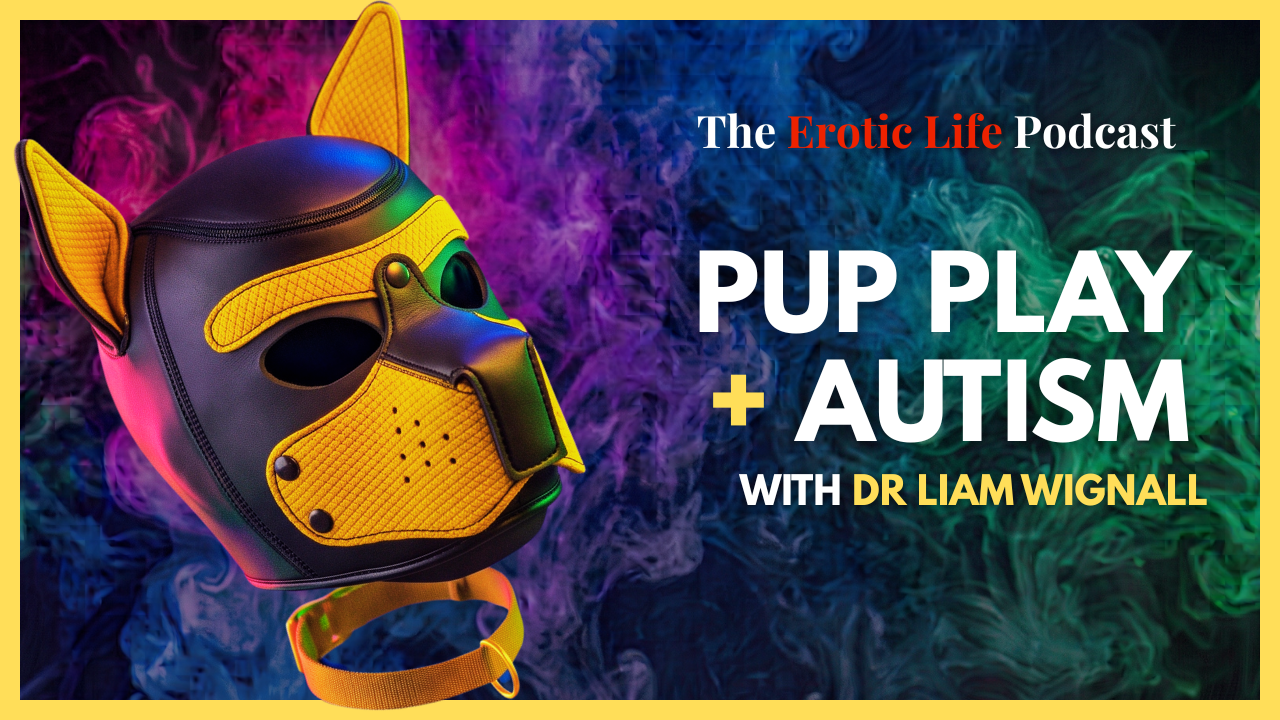
In this episode, we examine the subculture of pup play, what it looks like in practice, and why it offers such effective sensory relief and social connection. We discuss research showing that over half of surveyed pups score above the cut-off for autistic traits, and we explore what this community teaches all of us about explicit communication, boundaries, and intimacy.
Joining me to discuss this is Dr Liam Wignall. Liam is a Senior Lecturer in Psychology and a member of the Centre for Transforming Sexuality and Gender at the University of Brighton. His academic work focuses on LGBTQ+ sexualities, digital sexual cultures, and sex-positive psychology. He is the author of Kink in the Digital Age, published by Oxford University Press, and wrote the first academic papers to formally document pup play through a non-pathologising framework.
Key Points
Play and cognitive relief: Participants adopt canine behaviours to enter "pup space," a focused mental state that quietens analytical overthinking and daily stress. Over 84% of surveyed participants report that the practice improves their general mental health.
Neurodiversity and practical appeal: Liam's research found no correlation between autistic traits and being kinky; autistic people are not inherently more likely to seek out kink. However, roughly 55% of surveyed pups scored above the cut-off on the AQ-Short because the subculture's structure (clear communication, explicit boundaries, and reduced sensory overwhelm) offers an accessible, comfortable social environment.
Sensory and social accommodation: The subculture strips away confusing social subtext. Restrictive hoods, compression gear, and straightforward instructions create a predictable environment where autistic individuals can experience touch and connection without having to mask.
Communication over performance: Pup play relies on upfront negotiation, real-time feedback, and intentional aftercare. Removing performance pressure in favour of direct, transparent communication makes intimacy far easier to navigate.
Timestamps
00:00 Introduction
00:43 How Did You Get Into This Field?
04:12 How Did You Get Into Pup Play Research?
08:06 How Do We Learn To Be Kinky?
13:15 What Exactly Is Pup Play?
19:24 Looking At The Research
23:16 Four Key Findings In 'Be Dog Have Fun' Study
23:41 Conditions for the Rise of Pub Play
30:55 The Role of Social Media in Kink Communities
33:25 Was I Born Like This or Did I Pick It Up?
36:05 Effects on Wellbeing?
42:25 Neurodiversity and Pup Play
57:15 What Do You Think Pup Play Can Teach Us About Intimacy?
59:41 Being Kinky In Your Life. How Have You Intergrated It?
Transcript
Transcript: Please note: This transcript has been corrected using AI since the original software does not do a great job. There may be small errors.
Sergio Rebelo (00:00) So, today on The Erotic Life Podcast, I'm joined by Dr Liam Wignall. Liam is a senior lecturer in psychology at the University of Brighton, who focuses mainly on sexuality and gender. He's also known for his research around kink and BDSM themes, specifically around the kink subculture of pup play, which is why I've invited him on the show today. Hello, Liam. How are you?
Liam Wignall (00:26) I'm very well. Slightly tired, as this gets recorded on a Sunday afternoon/evening, so it's a yeah, this is like the end of the weekend, and yeah.
Sergio Rebelo (00:36) Yeah. A Sunday cold afternoon, I must say, because it's quite freezing here.
Liam Wignall (00:40) Yeah, it is it is cold.
Sergio Rebelo (00:43) So, I guess like, I'd like to start knowing more about you and how you got into this field. Why kink and BDSM, and then also why pup play specifically?
Liam Wignall (00:54) I mean, none of this was sort of planned. Originally, I was going to be a maths teacher. I really enjoyed maths at school, sixth form. And then sort of sadly fell out of love with it in sixth form, picked up psychology, and was like, that's fun. Fast forward to the end of the degree I did, I got connected with a few academics who worked in the field of sexuality and gender, and it was through conversations with them that they suggested a PhD might be a good option. I was at the University of Sunderland for my undergraduate degree.
Coincidentally, they had an opening for a PhD, fully funded, and it was one of the rare ones where they would just fund anything, you know, submit a project. So, I had ideas around an interest in sex and sexuality, and specifically the impact of the internet, because as a sexual minority myself, growing up at the same time as, you know, sort of when I was 17, 18, 19, you had things like Manhunt, Gaydar, GayRomeo, all these kinds of websites. And these were integral for allowing people to find connection, community, but not even just that, just like to talk to somebody who shares similar sexual interests. Sexual, you know, the gayness almost becomes secondary. You can just have an everyday conversation, "Oh, and by the way, we're both gay."
So, I was reading, as we do, like we tend to as people want to know about ourselves, I was reading around the research into sexuality, the impact of the internet. And as I was just doing random searches in the library, I came across some articles on kink, and then kind of went down the rabbit hole and just found that there was such a disconnect between the different narratives. That for kink, it was this underground nature, it was completely subcultural, difficult to access according to the research. Whereas the research on sexual minorities more generally was saying just how pivotal and impactful the internet was, and that geographical boundaries were no more. You can be in a rural part of the UK, or US, or anywhere, and connect with somebody, you know, without the need for the gay bar, or for the cruising, or, you know, whatever.
That just wasn't my understanding for the kink world either, that there were, again, specific websites orientated for that. Back in my day, looking at the multitude of different websites and what to sign up for, etc., there were things like Slavebwoys, there were things like Recon, which is still around now. There were places that all the arguments being made for sexual minorities, I was like, why are these not being applied to kink in general?
So, I identified that as a project, submitted the proposal, it was accepted, and then I ended up doing a PhD looking at the internet's impact on kink communities and subcultures, and the consequences of that: what that might mean, how it changes how people find kink, narratives and understandings of kink, how they go about exploring it. So, that's kind of how I fell into the field of research and sexuality and kink.
Liam Wignall (04:12) Again, the pup play research was I sort of fell into it. As part of my interviews for the PhD, the PhD was just kink, like it wasn't specifically on anything, I think it was interview two or three, I was like, "Thank you so much for taking part in this interview on the internet's impact on kink. I just want to start off by asking, how would you define kink?" They'd give me a definition. And then I said, "What are some of your interests?" And they said, "Oh, I'm into bondage, leather, rubber, power play, pup play." And I was like, "Oh, I've never heard of that one before," thought nothing of it.
Next interview, it came up again. Next interview, it came up again. Two more interviews after that, it came up. I was like, I have never heard of this thing, and I'd been immersing myself in in different communities and websites and whatever. This activity was occurring without people documenting it. So I was like, I found my niche! I found the way to, you know, do an academic paper.
So I started specifically recruiting for using some of those participants for snowball sampling, where they'd tell me about other people. And then, yeah, I started interviewing pups across the UK, documenting that this activity exists, first and foremost, because there was no academic papers on it. It was mentioned one or two times, and that was in relation to zoophilia or bestiality, having sex with animals, and they're completely different. And it was thought that pup play is like step one of step five or six towards bestiality, which isn't the case.
So I was like, I've got an opportunity to come at this from a psychological perspective, but more importantly, a way that doesn't pathologise, doesn't stigmatise, doesn't make that link to zoophilia. Because part of the research I'd been doing into kink, I was seeing just how damaging my discipline of psychology had been for kinksters. That kink was in the DSM, the Diagnostic and Statistical Manual, you know, used to diagnose mental health issues, concerns, etc. It was pathologised, it was stigmatised. There are examples of people losing their jobs, their homes, their families, because of engaging in kink.
So I was able to be the first to document, look, pup play exists, from a non-pathologising perspective that just focused on the narratives, the playfulness, the benefits of people who engaged in it. Yeah, and then fast forward, that was I think my original article came out in maybe 2015, '16. And I've been doing various projects into pup play ever since, for the main reason I had a research mentor sit me down when I was saying I kind of want to get out of the pup play research, like I'm getting known as the pup guy in academic circles. And they just said to me, "You've got your niche. It's better to have a thing that you are known for, that you are the expert on, that you can kind of control the narrative to some extent of what is being said around pup play."
And I think that, you know, I'm doing that. And I know we'll talk about this later on, but the research into neurodiversity and pup play, and kink more generally, same thing: I'm able to control the narrative and say it's not a stigmatised and pathologised way that we should think about this, or you know, it's not, "Look at these outsiders being attracted to outside activities." It's, "Look at these people who are finding ways to enjoy and just be themselves." So, a long-winded answer, but that's how I, yeah, ended up where I am now.
Sergio Rebelo (08:06) Yeah. So, it kind of comes off your own personal experience of coming into kink identity, you know, what what is it yourself that you like? It's your your own experience you're capturing there. What stands out is how much the internet played a role in finding these communities and understanding what's happening around me, what does it look like, and this sort of thing.
Liam Wignall (08:29) Because we know that kink is when I would kind of speak to my participants to ask, you know, how do you how do you do kink? How do you explore it? Where do you learn how to be kinky, or that kind of stuff? They emphasised just how much there's an importance of in-person interactions, of that dynamic nature between between two or more people. But when you're stuck in the the Highlands in Scotland, and the nearest person around you on any app is 200 kilometres away, I'm not saying that it replaces it, but having opportunities to stay connected is is useful, is powerful.
And it might not be, you know, stay connected, it might be the only way that you connect with other people. We know that for other sexual minority communities, places like Tumblr were integral to allowing people to explore or explore components of their sexuality, their gender, the overlap between them, and not even that, just, you know, beyond sexuality and gender. People who have niche interests, Dungeons & Dragons players. I think of nerds and geeks, and I think of them lovingly, but it can be, you know, difficult, particularly as teens, young adults, to find your tribe.
The internet allows for that. Is it perfect? Absolutely not. There's so many critiques and, you know, I've done blogs with Recon before, and I give talks at London Fetish Week masterclasses, and we talk about the pros and cons of the internet, and it, you know, is more complicated than that. It's: here are the benefits, but also the disadvantages and things to look out for. But yeah, the internet has played such a huge role.
Sergio Rebelo (10:45) Yeah. Especially with this particular subculture, which I think we'll touch on more in this study.
Liam Wignall (10:50) Yeah.
Sergio Rebelo (10:51) I am wondering, because you did say that you are creating the narrative or you're helping to illuminate what there is and what there isn't, which is a lot of responsibility. What kind of reception have you had in terms of this from people?
Liam Wignall (11:03) I mean, from the academic community, I'm just the pup guy, which is annoying because my book is not on pup play, it's on kink and the internet. From the community, I like to think that what I do is is well received. And there's different communities, right? You have kinksters in general, you have the pup community specifically.
But I think one of the things I've done with the pup community specifically is I've been there, in the sense of when there was kind of maybe pivotal moments, I would argue, or big moments within the UK pup scene, I've been there. I've been interacting with people, I've been communicating. And I think, you know, it's not just, here's a community I'm researching and then distancing myself. I'm still kind of engaging with some of my original participants. I'm still finding out and asking questions around what are developments of things going on within the pup scene.
One of the ways that I try to think about my responsibility with the pup and broader communities is through podcasts like this, that I disseminate my results in different ways. I don't just think about it as an academic paper and then move on. I give talks at multiple places. Whenever I'm asked by community people to take part in podcasts or content creation, you know, I do it. There was a podcast I did with Barney the Clown for The Big Top, which is very much a kink-focused, playful, silly podcast. That is, yeah, that's one of the ways that I still maintain that connection with the community, or communities.
Generally, I've had messages from people saying that they read the blogs, or they listen to different things I do, and they like it, they enjoy it. Touch wood, I've not had any negative You know, I've had pushbacks on my arguments, which I think is so important, because I can only see so much, I can only experience and write about so much. So yeah, I get engagement and pushback.
One of the things that stands out to me is the first talk I ever gave at the Recon masterclass was just on my book and my research on developments in kink and the internet, and a very old kinkster, 70s, 80s, came up to me and was just crying, saying, "The fact that you're able to be up here just talking about this kind of research that you're doing is crazy. I never thought that I, when I was kind of in my 20s, 30s, being a kinkster, you know, and my identity as a gay kinkster would be in the DSM, would be, you know, illegal in certain parts of the world, and it still is." Yeah, so that kind of feedback of some of the people from the older generations recognising the work I'm doing is one of the things that brings me validation that I'm doing the right thing, I'm making the right arguments, and spurs me to kind of carry on and do more.
Sergio Rebelo (13:15) Well done. It is quite profound to have a foothold in the kink environment and also to be a voice, you know, and a voice where, you're in the academic world so that's a voice. There's a bridge there between the practitioner world and then the academic world. I'm in a therapeutic context so there's a therapy world as well. So, I think it's so important to have these different voices in different places. It means a lot to different people.
It's a simple question, but I think foundational. So, I know what pup play looks like. You know what pup play looks like. But for some listeners, they may not. So, I'm wondering if you can describe what a person would expect if they were to see a pup play scene, or people participating in this?
Liam Wignall (14:02) Chaos. Utter chaos.
So, I describe pup play as an activity where people take on the animalistic qualities of young dogs or pups, engaging in associated behaviours: barking, biting, scratching, licking, nuzzling. For some, it is a completely social activity that getting into this kind of playful mentality provides two things. Firstly, it can be a form of relaxation: that when you are in that role, the pup play role, your thinking switches off, and you haven't got an exam a week from now, you don't have deadlines with your job, you just, you know, you are able to kind of be in the moment.
And then, if not relaxing, there's the playfulness aspect of it, hence the name pup play. That the activities that you see are very interactive, energetic activities where people will be a level of tactile, they'll kind of roll around on the floor, they'll play with balls, passing them to each other.
You have that social side; you also have the sexual side, that actually there's elements of dehumanisation associated with it. You're not your everyday person anymore, you're a dog, you're a dumb dog. And that can play on the humiliation aspect, that actually being on all fours, having that very clear element of power exchange can be erotic, can be sexually arousing for some people.
For the majority of people I've interviewed, and I still think this is the case, they sit somewhere in the middle: that it can be a social and a sexual activity, and it depends on the context who it's being done with, and the head space, and even the environment. The majority of over the years, there have been various pup events, and they've been held in pubs or clubs that don't have a sex licence, so there's just a real emphasis on the social nature of it.
One of the key things I think with or two things that come to mind when thinking about pup play in relation to our conversation, is number one, it can provide a platform for exploring other kinks. So if you go to a Pride march and you see the pup play section, no two pups will look different because everyone has their unique individual identity, but you can have elements of leather, rubber, Lycra, harnesses, masks, different forms of mitts and gear. The nature of pup play and contemporary pup play and how it's being done, there's no right or wrong rules, so it's a way of exploring and experimenting with other kink activities.
And I think it's one of the ways that people are able to find an element of a community, that there has just consistently been a pup play community in different forms. Broadly speaking, it is a kink activity with social and sexual elements and a strong community behind it.
Sergio Rebelo (16:34) Yeah, growing. And it's growing more and more, absolutely.
Liam Wignall (16:38) I don't know if it is. I thought this a year or two ago: are we starting to reach the pinnacle of pup play? Because I've been researching this for well over 10 years now, and we have, I think, moments have already been done. We've had in Mr S Leather, the kink shop in San Francisco, there's Puppy Park. When that first came about, it was a huge section.
Sergio Rebelo (17:10) What is Puppy Park?
Liam Wignall (17:12) It was just a section of the store where they had all the pup gear. On the wall, they had 50 different types of the neoprene mask, which was like the famous, big Mr S mask. And now it's a much smaller section. The dildos are taking up a bit, and fisting is taking up a bigger part of the wall.
You know something has become big when you see places like Temu or Wish doing versions of it, and we saw the Temu hoods, we saw the Wish hoods. There are established aspects of Pride parades now where you see pups. We've seen pups on TV, on music videos. One that springs to mind recently is Years & Years, I think, had pups in one of their music videos.
I don't know how much bigger it can get. The New York Times in 2016, I think, had pups on their homepage, on their main website. I wonder if there's been a peak of pup play. And yeah, I don't know.
Sergio Rebelo (18:41) I think in my therapeutic practice, I work with kink and BDSM quite a lot, and pup play is something and when I mention certain kinks or expressions of sexuality, I kind of watch the reactions that some clients may have. And when I say pup play, they feel very unaffected by it. There's no surprise or shock or question, and I'm gauging that with how enmeshed it is within the community and how much it's spoken about. So, it doesn't seem to have that shock value, but that's not to say that it hasn't reached its peak, so I'm hearing what you're saying there as well.
Liam Wignall (19:08) Yeah, and I think once once you see pup hoods in mainstream fashion, or mainstream music videos, or talked about as a throwaway comment on Drag Race, it's no longer that kind of shock value of, "What's this?" in the same way that it once was.
Sergio Rebelo (19:24) So, there's two papers I want to kind of zoom in on, more so the recent ones. The first one is a 2024 paper, it's got quite a big name: 'Be Dog, Have Fun: Narratives of discovery, meaning, and motivation among members of the pup subculture'. So, I'm curious about this paper. Where did it kind of come from, and what was the process in in making this study?
Liam Wignall (19:50) The motivation was myself and my co-author Phil Hammack were like, "Why have we not published more together? We need to do some sort of studies." And Phil Hammack has been instrumental in the San Francisco kink/pup community, so we have overlap and interests in kink and pup research.
Prior to this paper, I'd done a collaboration with an Australian community member, Taylor Cook, on an annual survey of pups. That was a community-led research project that asked a bunch of different questions. We used that data and done a different publication from it. And then, we thought it was a good idea, we put together a more academic-focused version, so rather than being community-led, it was research-driven.
We had a lot of different questions from the same surveys where the data on neurodiversity came from. And speaking with Phil, the collaborator, he thought it would be interesting to build on some of the small qualitative research that I and other people had done on understandings and experiences of pup play, and ask it kind of on a broader scale. Because one of the critiques of my research is the majority is UK gay and bisexual men. So to think about those narratives beyond gay and bisexual men and beyond the UK would be is important.
So broadly speaking, we asked three open-ended questions on the survey around meanings, experiences, and identities: "How did you get into pup play?", "What's it mean for you?", and something else. We combined these together and did an analysis of all the different responses. The majority of what we identified in the smaller qualitative research was applicable in the larger qualitative research: that there was a social and sexual element, that it's a gateway into other kink activities, that there's socio-sexual reasons for it.
To just be able to make those claims now using a larger sample, international, with a greater gender and sexual diversity in the sample, is good, so I'm not just making claims on my kind of small sample, we have the larger one. And when we kind of got the quote of "Be dog, have fun", we were like, that's the title!
This paper has one of my favourite lines that I've managed to get published in it. We did the analysis, and one of the foundational questions was, "Why do you engage in pup play?" And at the end of the results section, a participant says, and don't quote me completely, but, "While not large enough to be a theme in itself, one participant provided the most important response for why they engaged in pup play: pup play is the only kink activity with snacks. Who doesn't love snacks?"
And I think that, you know, it is like a throwaway fun thing, but it really exemplifies the playfulness of pup play, that it is just, yeah, you can do it how you want.
Sergio Rebelo (23:16) I think when I read that, there were these four kind of key findings, which you've touched on already in some ways. But there's an extraordinary effort there that goes into the context and history of how pup play emerges in time, and where at a very specific point. I think it was like 2010 around that decade where it really sort of came up into the scene.
Sergio Rebelo (23:41) What allowed it to arise, do you think? What were the conditions to allow such a subculture to sort of break through?
Liam Wignall (23:55) Three things spring to mind.
The first, I think, is around the changing nature of kink subcultures more generally. As attitudes towards sexual minorities changed, and there became a broad increasing acceptance of different levels and of different identities and groups, that had a knock-on effect to the kind of visibility that we would see and what people felt comfortable engaging in.
So things like legalisation of gay marriage in the UK and in certain parts of the US, big Pride parades being visible, increased visibility of sexual and gender minorities in TV shows and movies, and kind of a peppering of, if not kink, just like maybe subtext to it. I remember as a child, there was a CSI: Crime Scene Investigation episode, which was a detective show that came from the US, and there was an entire episode based on furries. That still sticks with me now! It's like, how did that end up on mainstream TV?
Seeing more examples of these has the consequence of increased visibility, and broadly decreases stigma, to some extent. As a consequence of that, the boundaries around kink subcultures potentially started to open up. In the UK for years, and I don't know if it's still like this now, but there was a common thing that munches, so meet-and-lunches, predominantly for heterosexual kinksters, would happen in Wetherspoons because it was cheap, every city had one, you know. And it's not that you've got everybody in full leather engaging in BDSM in the middle of Wetherspoons, but you would see visible examples of people with collars on, or people maybe sat a bit lower down compared to somebody else.
So, because of that, that's kind of one aspect.
The second is and there's kind of complexities with the argument is around Old versus New Guard. There's broad arguments around actually that isn't a distinction people should make, but the broader thing around it is older ways of engaging in kink were so focused on protocol, on rules, on regulations. That was partly around the need to be insular and protected around your community, around your subculture, around your identity, that you needed to invest.
There are old stories that you had to earn your leathers. You couldn't just go into Prowler Red and put regulation, put the entire thing on and say, "There you go, thank you." You had to earn that. If you wanted the good stuff, you'd have to get recommended. You couldn't just walk into a place and be a dominant or a top; you started from the bottom and worked your way up, and you experienced and invested.
As boundaries became more fluid and there became increased visibility, there became sort of less control over those more discrete and insular and close-knit communities, that allowed people to say, "Hang on, why should I have to do A, B, and C? This leather jacket turns me on. Why am I going to spend years engaging in these activities for someone to allow me to buy this? It doesn't make sense. I'm going to go to AllSaints and just buy a leather jacket, a good quality, whatever."
So there became that kind of pushback. The movement away from rules and regulations and roles, and a focus more on like, actually, we could do kink in different ways: we can wear rubber and leather, not everything has to be protocol, there can be more playfulness to it. That's what I mean by the move from Old Guard focus on protocol and rules and regulations to more towards contemporary kink as we see it now. Where still people engage in protocol and it can be really fun and really hot, but there's also a broader playfulness. If you turn up to any of the events that Recon does for Fetish Week or for cabaret, the room is completely different in terms of what you see, different outfits, different kinks, etc. So I think that focus on playfulness has allowed new and different things to occur.
Point number two is pup play came about naturally, I think, as part of that narrative: that the dehumanisation aspect didn't have to be slave and master, that it can be submission. Actually, there's a really fun way of, you know, it doesn't have to be "you are just a piece of meat." It can be a bit more teasing, it can be a bit more playful: "You're not really a human." These are different ways of speaking to people. And the animalistic dehumanisation side of things just played into that perfectly.
There's no clear route to how pup play developed. There's one article that focuses on the history of pup play and identifies completely different things to me and focuses more on that first narrative. Whereas in my book, I spoke to some of the people who were at the early Chicago IML events, and said, "I was there being on all fours, or pretended to be a dog just on my own, and then somebody came over and we had a fun time. We thought, let's do that next year, and it just built up and built up and built up."
I remember very early on in my interviews with participants, so again like 2013, '14, '15, there was just people turning up to kink events with a pup hood on, and people were like, "What is that?" It just started to kind of, "Oh, you're into that? What is it? That sounds fun, let's do it together." So it had that kind of snowball.
There's no real entry point to pup play. If you have the mentality to get on all fours and pretend to be a dog, you're doing pup play. It's an easy way of engaging in a lighter form of submission and domination. Yes, there's heavier dehumanisation pup play, or dog play, human dog, whatever, but the pup play that I kind of describe and focus on allows people to explore without barriers, without the price point of expensive forms of leather or rubber. The people I interview, when I ask about barriers and how do you get into pup play and what's needed: you need the mentality, and if you want to invest some level of money, you need mittens for your hands to protect them, and knee pads because you're on all fours.
So I think that really helped. So you've got number one, changing narratives around kink. Number two, the fact that here is an activity that works so well with other kink activities, and there's no real entry.
And the final one, it just came about right place, right time in relation to the internet, and specifically I think I focus on Twitter. Before it became the hellhole that it is now, it was a space that people could explore, create different identities, have a level of distance, you could have multiple Twitter profiles, and it allowed this kind of creation of an online community. The people who engaged in pup play, because of the nature of it, energetic, being on all fours, and it's a way of people being introduced, it tended to have a younger crowd. The younger population 10 or so years ago were big on Twitter, were big on early forms or different forms of social media.
Sergio Rebelo (32:00) Yeah. And also it's quite accessible. It's not the most expensive fetish, people can actually it doesn't require a lot either, so people can enter into that way, that doesn't limit them.
Liam Wignall (32:14) Yeah, and it's not only that in terms of the accessibility of the activity, but the reason, or one of the reasons I argued back in the day, again before massive social media changes, was it wasn't people having to learn a new website and invest in it and generate A, B, and C. Twitter had the app on the phone, people knew how to use it because they already had a profile, it was easy to switch between the two, and it was just kind of accessible.
Imagine if there was just an app or a website specifically for pup play, people wouldn't engage in it in the same way. Whereas Twitter, it was already on their phones, the affordances provided by Twitter were appealing to the pup community: that you could share pictures, there was a real kind of social media buzz, you could create these identities.
And I even think early on there was such an opportunity to kind of be a popular pup. I think now of Pup Boedi and Pup Xander and Pup Amp, like there are kind of some of the bigger people who've really done well for their kind of pup identities. 10 or so years ago, I could name 20, 30, 40 popular pups that had thousands of views and followers from across the world. So it was also an opportunity to just, you know, live your best pup life and also get the attention and validation that we need on social media.
Sergio Rebelo (33:25) Interesting how you talk about this part of subculture being in the visible realm, so we can see it everywhere. And this leads on to one of the second findings that you have, and it's a question I think many kink people have, which is: was I born like this with this sort of interest, or did I learn from it? Did I learn about it, and that's how I got interested in it? So, your research did look at this question. I'm curious to know what you...
Liam Wignall (33:55) I mean, it's the idea of kind of intrinsic, extrinsic motivations...
Sergio Rebelo (34:04) The essentialist versus constructivist narratives, yeah.
Liam Wignall (34:09) Yeah. And, you know, it's both. That's what I think is so good about kink and and pup play in general: that it is socio-sexual, that it is intrinsic, extrinsic, that it can be everything depending on who you're speaking to.
For some participants I spoke to early on in the pup research, it was like, "No, the minute the hood goes on, this is just sexual. This is being what I needed." Versus other people that, you know, it's a means to an end, that they want tactility, they want to have an element of sub/dom, and pup play specifically just works and ticks all those different boxes.
One of the things that I don't talk about in that article, but comes out more in my book, Kink in the Digital Age, the final three chapters of the book is a case study example of pup play. And in the final chapter, I conducted follow-up interviews with 10 of the original pups of 30, to find out how their engagement and understanding of pup play had changed. Not all of them were pups anymore. Pup play served a tool, and their primary or master identity went from being pup, like Pup Hunter, to Hunter Leather, or Hunter BDSM. That master identity went from being pup to something else.
For some of the others, there was still pup, it was still that kind of primary thing. Actually, age did play a role, that they engaged in pup play less because of the logistics of getting down on all fours, or you go to certain events and they do tend to appeal to a younger crowd, so, "I still want to do pup play, but I'm almost being pushed away from it," which is sad.
In terms of essentialist versus constructivist narratives, it's both. It's this internal thing that, "Oh, this is something I think I really want to do," and also just like, "I didn't know I want to do this, it feels fun, I'm going to do more of it."
Sergio Rebelo (36:05) The third and fourth discoveries were central around wellbeing, and that was around the individual benefits you touched on this at the start as well the individual benefits that a person can get, as well as the social benefits. I wonder if you can maybe just elaborate a bit more on that?
Liam Wignall (36:26) Pup play primarily, I would argue, is a social activity. People who engage in it will do so at events or with other people, and it is rare, but not uncommon, to engage in pup play on your own.
In terms of those kind of benefits, it's being in that community, it's being seen, it's being validated, it's being accepted. And this is, you know, I've not mentioned pup play, this is just like the community aspect around it, which I think is so important and does come out in some of those participant narratives. You know, "Why do you enjoy pup play?" "Oh, I love the community, it's so welcoming, it's so accepting."
I'm doing a follow-up study on neurodiversity and pup play, and it's similar answers. For some of those participants, about why you're attracted to a pup community, it's like, "I'm neurodiverse, I'm in this room, and no one sees my neurodiversity, they just they just see me." And I think the ability to be our authentic selves, as I'm sure you're aware, has huge positive impacts on our mental health. In a world where, yes, there are broadly increasing acceptances for sexual minorities, it can still be difficult to to be authentic, to be ourselves.
I'm lucky that in Brighton I walk down with my nails painted and holding my partner's hand and doing different things, but actually when I go to rural towns, it's a bit like, "Oh, I forgot how good I have it in Brighton," and that, you know, sometimes I do feel a bit, you know, a bit different.
So I think you have kind of the social component in terms of benefits, and then the other aspect is more individualistic: that getting into that head space can be relaxing. The other way of thinking about it for listeners who are like, "What is this head space about?", is to think about like mindfulness or yoga. Actually, when you focus on activities such as breathing, or you really focus on the sensations that you can feel in your body, you enter that flow head space. Not easy to do to that extent, but you feel better at the end of it. Like, you speak to people who do yoga: "Oh, it's fabulous, you know, I feel so relaxed and rejuvenated afterwards."
Something like long-distance running: you have the running benefits, but actually people describe, "I ended up running 12k without realising it because after 8k I just got in the moment." And it can be the same with pup play: that you enter that pup space or pup head space where you just let go, and your thinking becomes more sluggish, but also more restrictive. You see the ball, you get the ball, you've got the ball. You see somebody, you want to pounce on them. There's none of that additional cognitive load.
It's not, "Whose ball is that? Oh, I need to ask permission. Oh, I don't know that person. Oh, I'm going to have to go and say hello." You know, it's just instinctual.
There are some participants, or some people I know, who engage in pup play as a solo activity as well, that actually putting on the hood just sat at a desk or in the house or whatever can help them get into that head space of relaxation, of calming. Actually, there are aspects of pup play that really lend themselves well to relaxation techniques. The pup hood itself, depending on which one, can be quite restricting: it can limit sound, it can limit vision, it reduces kind of sensory information. It allows kind of different levels of thinking. I think mindfulness or yoga and those kind of activities where you can enter a flow head space are the best ways of understanding the individual benefits of pup play.
Sergio Rebelo (40:34) And this is a separate study, I've got this quote here from findings from a community survey you did on individuals who engage in pup play, and it was 84.04% of participants believed that pup play improved their general mental health. So, it's a high statistic.
Liam Wignall (40:55) Yes, and they are self-reported, so we need to be careful, and how that question is interpreted by participants can be massively different.
I spoke to a researcher in the US who tried to do a brain scan study on pups to look at elements of what lights up in the brain, and we talked about the fascinating nature of it. There was so much noise in the data because of the chaotic nature of pup play that they can't publish from it. There's some tentative findings that actually the parts of the brain that light up when they're engaging in pup play are the are the relaxing or the parts of the brain I'm not a biologist are the parts of the brain that are related to sort of other relaxation activities.
We've hypothesised that actually it'd be such an interesting study to look at levels of testosterone, oxytocin, dopamine pre- and post-engagement in pup play, because we would hypothesise that the happy hormones would go up, the stress hormones would go down. Because, you know, the other thing I've not mentioned is the tactility involved in pup play. We know bonding with or touching people, consensually, and having kind of human contact has wonderful benefits for the regulation of our body: that we feel better, and chemically, neurotransmitters demonstrate that as well. So, that 84% logically makes sense to me.
And certainly in when categorising pup play as a form of serious leisure, there's six defining characteristics of serious leisure and the final one is kind of long-lasting benefits. We don't know the extent of the long-lasting nature of it, but the comparisons for yoga and mindfulness, etc., we see evidence over a long period of time, so I would hypothesise that the same would be present for pup play.
Sergio Rebelo (42:25) You mentioned autism quite early on there, and that actually takes us quite nicely into the next paper you did and I'd like to look at, which is the autistic traits of people who engage in pup play. This feels quite new in the field, looking at the intersection between neurodiversity and kink. So, how did this paper come about, and can you say a bit more about it?
Liam Wignall (42:52) I was in the Royal Vauxhall Tavern with Phil Hammack, the author of the other paper, and I was showing him a pup event. I'm fairly certain it was the year that Recon put on a pup play event. Again, the fact it was in the RVT, it was completely social, it was a social event, but you walked into the RVT and it was just mats on the floor in the main bar area, and it was chaos, in the most wonderful of ways.
I was in researcher mode, I think about it when I'm in these spaces and kind of think about questions and whatever. I was in researcher mode and I observed a range of different social behaviours, norms, that made me kind of question and think, you know, these are unusual. Examples being some of the people who were having a conversation were stood very close to each other; that for some individuals there was a very clear no touching; some individuals were kind of just sat on their own.
I saw various of these things and sort of thought nothing of it, but then one of the connections I have with the pup community kind of came over and was chatting away, and I commented to them about what I saw. And they were just like, "Well, that makes sense, you know, we're all autistic."
I kind of laughed, I was like, "Oh, okay, you know." And it was clearly meant in jest, but was a comment based in somewhat of reality. And I just thought about it more and more, and over the next kind of 6 to 12 months, as I went to more events and spoke to more people and spoke to other academics with connections, there seemed to be more conversations and just acknowledgement of neurodiversity within pup spaces, and within kink spaces more generally.
The same thing happened that I thought: if somebody doesn't get, and as you say, there was no research on this and there isn't that much research currently, the same thing happened: that if somebody with that kind of sex-positive way of viewing these things doesn't get in on it first, it could be disastrous.
So, I reached out to a colleague, Rachel Moseley, who I published a paper with, at Bournemouth. She is an expert in autism, she knew nothing of pup play, and the conversations we had prior to the research were fun. And yeah, we did an online survey as part of this was at the we did an online survey, and one of the last group of questions on it was the AQ short form. Earlier questions were around the narratives, and mental health aspects of pup play, community, and just general characteristics.
We were surprised by the results. We expected somewhat of a higher preponderance of autistic traits based on our observations. The idea of one in two participants scoring above the cut-off, which is likely indicative of an autism diagnosis, was just was very surprising.
Sergio Rebelo (48:05) Yeah, I have it here, it's about 55% around that mark. Yeah, that's quite something.
Liam Wignall (48:12) Yeah, so the cut-off is, just in terms of the broad stats, the cut-off is 65 on the AQ short form, and that is likely indicative of autism, or this score might be an indication that a more formal autism diagnosis could be sought, you know, that justification. It's so important to say that this isn't an autism diagnosis, and it's not as clear-cut as you score above this number, you're autistic.
There's also a more strict cut-off point of 70, because between 65 and 70 is where there might be an overlap between ADHD and autistic traits. But even with a kind of more strict cut-off, it went from one in two to one in three, which in the general population, I think it's 1 in 49 off the top of my head, a huge difference.
Sergio Rebelo (49:40) Why do you think autistic people are interested in this, or would be interested in pup play?
Liam Wignall (49:48) Well, that's the study I'm doing now. So I've interviewed I think 11 or 12 autistic people who engage in pup play for those kind of same reasons. Myself and Rachel hypothesised and thought about how to understand this.
I think one of the things we identified was community: that neurodivergent people, particularly autistic people, may feel a bit disconnected from society, and to have a group of people who just get them might be important.
And then we thought about the features of pup play specifically around the gear: that it might be that there's something nice about the restricting nature of the gear and the idea of kind of the reduced sensory input.
In the interviews, that's two of the reasons that we found that the participants I spoke to, I think of the 11, 10 were one was autistic, the remaining 10 were autistic and ADHD, a mixture of self-diagnosis and formal diagnosis. Because of the difficulties with achieving a formal diagnosis, we accepted that, as is done in other research.
One of the common narratives that came up was the pup play spaces were welcoming for all people. So when I told you about being in the RVT, one of the things that I was speaking to my colleague about we commented on was the range of people there: that there were different body sizes, there were different gender presentations, there were different ages, different levels of gear, different ethnicities, even though it is kind of predominantly white from what we saw and still seems to be that way in pup and kink communities in the UK. For that event, it was a mixture of cisgender and trans men.
So, for the participants I interviewed, the autistic pups, they commented that actually just adding neurodiversity onto that was just like you still feel accepted and understood and validated in these spaces. Not only that, that there was this kind of snowballing effect that the participants I interviewed, when they went to these spaces, they knew there were going to be other autistic people there, and that made them feel comfortable, and that was one of the reasons that they went to them: that there's a lack of needing to explain oneself all the time and defend oneself. No two manifestations of autism are the same, but participants were able to say, "I didn't felt like I needed to, A, hide anything, or B, defend anything. It was just, 'Oh, cool, you don't want to be touched? Yeah, that's fine.' 'Oh, you need to have a five-minute break over there because this is a bit socially overwhelming? That's cool.'" You know, it wasn't, "Oh, that's not a social norm, that's not what you normally do." So participants just really valued that.
And then the gear came up as specifically beneficial: that a reduction of sensory information in terms of the vision on the hoods and the ears, the fact that it allowed them to engage in different forms of gear. One participant absolutely loves all-over bondage, all-over restrictions, so the idea of kind of having a neoprene suit or a rubber suit alongside pup play, for them that wasn't sexual, it was just like, "This feels so good, I feel like I'm in control of my body." Whereas another participant hated that idea, and they were able to have kind of a rough-stuff style hood with kind of more space.
Because of the nature of pup play and the versatility of it, they were able to do what they want and made them feel comfortable.
Sergio Rebelo (53:30) There's something about the clear boundaries as well and clear communication. So, "do this, do that." If I'm a handler, "get the ball," and it's these clear what's expected of me? People can struggle with general anxiety around sexual function: what do I do in the bedroom, what do I not? And this is in any kind of form of sex or kink. And this is one that really lends itself to, here's what I want you to do, which will please me or make me happy, and I can see it makes you happy too. So all you need to do is just follow these instructions, and it's such a relief for anyone, I think, but it's such a relief and release of, "Here I can actually just be and exist in this space, and I know what's expected and I don't have to think about anything else."
Liam Wignall (54:15) And I think one of my one of my tentative things is that we did another survey, I forget which one, but looking at is there a correlation between one's kink orientation, how kinky they are to some extent, and their scores on a scale of autistic traits? And we didn't find a correlation. So it's not that autistic people are more likely to be kinky, and I think that plays into exactly what you've said: that it's the nature of kink.
Because there's such an emphasis and privilege on clear communication, instructions, consent, likes, dislikes, that you can create a list of different things that you want to do beforehand, that there's ways of navigating sex and intimacy. Think of I mentioned the tactility of pup play, it's a way of having intimacy that you're arguably in control in: that you can have somebody kind of scratch your head, enjoy that, and the minute they start trying to do something else, if you're in pup mode, you crawl away! If you're in handler mode and the pup doesn't like it, they'll bite your hand, or bark, and then crawl away.
There's ways of you don't feel like you've broken this whole social norm or this expectation. It's not going to yeah, part of that acceptance within those spaces is if something is said, like, "Oh, actually I didn't like that," it's not, "Well, now I need to overthink about this for the next three hours because I've clearly ruined everything." It's, "Oh, you didn't like that? Okay, cool. You liked this? Okay, we'll do more of that." It's more just practicalities.
These are blanket statements I'm making, and obviously there's an individualistic nature to kink, to neurodiversity, and to just people in general, but some of these features are what might be appealing to autistic individuals.
The claim I was going to make, sorry, because I just remembered it, is I would almost make the claim that for some autistic people who engage in kink, it's not that they're kinky, it's that they enjoy the other aspects of kink, and kink is kind of something that they might engage in because it's kind of fun, it's enjoyable. It's not my thing, you know, I might prefer vanilla sex, but there's other real benefits of it. And I think that is a potential interesting research pathway question to go down.
Sergio Rebelo (56:10) As in like it's just a decoration, the pup play is like a decoration around something that's more clearer and structured? Is that what you're saying?
Liam Wignall (56:20) Yeah. An autistic person might engage in pup play and might not be completely engaging in it wholeheartedly, but they might think, "Well, actually, if I pretend to be a dog and it's kind of fun, whatever, but the things I get out of it are: I'm able to get tactility from this other person in a way that I enjoy, I feel control over, and there's clear boundaries of what we like and what we don't like."
And beyond that, you know, I'm very aware of people who will turn up to pup events and not engage in pup play, they'll just engage in the community aspect of it. And it's that element of like, you know, yes, we're all into this same thing of kink or pup play, but we don't have to do it in the space, we can just chill as non-pup, or yeah, in everydayness.
Sergio Rebelo (56:55) Yeah. What I hear a lot of, and this is what I think the pup play community exemplifies, is when things are spoken about, when things are more transparent, when things are not expected of you and it's much more negotiated, that sets the conditions for pleasure and arousal to flourish. So it's a real insight into what would happen if we were just able to talk about what's worrying us, what excites us, what you might do, what you might not do in the session, what I'm nervous about. And that conversation, or that kind of framework that you go into, if it's there, it's going to make the the experience much more pleasurable on all fronts.
Liam Wignall (57:08) Yeah, and I gave a Seed talk, Seed talks are events that happen across the UK on a range of different topics, and I gave one on sexual wellbeing and intimacy. And kind of the takeaway message that I just gave to a general audience, non-kinky, mix, whatever, was just the most important aspect of sex, and one of the things that I do think we can take from kink, is communication. Consent is the thing that's heralded as the thing that kink does well. No, it doesn't. The consent frameworks, SSC, RACK, PRICK, all these kind of things, there's a disconnect between what academia says, what practitioners say, and what is actually done.
What the kink community, or people who engage in kink, do well is that communication. It's not, we're going to do a list of activities and we're going to talk about the big C-word of consent, but it's just the the ways that communication and feedback is done: that actually aftercare is integral within kink, and that's not related to consent, that relates to communication. The chat beforehand of likes, dislikes, and things that, you know, if this goes wrong, and chatting to other prospective people of, "Hey, I've been speaking to this person, do you know them?" "Oh yeah," you know, all of this is kind of communication.
And within general, within non-kink settings, I think applying that concept of communication would do wonders.
Sergio Rebelo (57:15) This kind of leads us near the end of the episode, and I'm wondering, in everything you've kind of learned and seen and read, what do you think pup play can teach us about ourselves, or our erotic selves? What kind of stands out?
Liam Wignall (57:33) I think it's the play nature of pup play. That sex, kink, should be fun, should be playful.
I think there's so much pressure in sex in general to perform well, to look a certain way, to act a certain way, to to be, you know, a sexual being. Sex is weird, sex is intimate, sex is you are seeing aspects of somebody's body that they don't show to other people, that you're being intimate with somebody in a way that, you know, they potentially haven't with other people, or you create your own dynamic and you create your own intimacy, you create your connection.
I think if we can kind of take some of the playfulness of pup play to sex in general, I think it could be so much more fun. And that communication, to have chats during sex, before, after, around what works, what doesn't. As part of that, and yes in pup play it might be barking, it might be crawling away if something isn't good, but to take those elements of these people are able to communicate in different ways around what works, what doesn't, what is enjoyable, what isn't.
If we can do that alongside forgiving ourselves in erotic environments, and just focusing on like, this is weird. We're not taught how to do sex in school in terms of sex education. Society generally limits discussions and discourse around sex, and what we see on movies, on representations, on porn, they aren't real sex, that's not good, accurate representations generally. Of course we're going to get things wrong. Of course things are going to be a bit awkward, like my arm's going to be in the wrong position, my hair's going to be in my eyes, the neighbours come home and it distracts, or you forget that dinner's cooking, all the different things that are occurring. Accept that, laugh, and yeah, learn and move on.
Sergio Rebelo (59:41) Fantastic. There's one final question I want to ask, and this is maybe a bit more personal in your journey as being personally involved in kink, as well as an academic. What I kind of see is many professionals come to me and struggle with integrating their kink side into their professional life. Like they withhold it and they don't say it. And you're very outspoken and you're very, "This is who I am and I work with gender, sexuality, and kink." And I'm a therapist whose niche is BDSM and kink. But as I said, I meet a lot of people in my room who don't want to disclose what they're into, what they're aroused by. They might be a slave, they might be a pup, and they withhold that because they just fear so much the potential stigma and judgment. I'm wondering, how easy was it for you, or difficult, in bringing your kink or erotic life and self into your everyday?
Liam Wignall (01:00:46) I recognise that I occupy a very weird space. What I do, who I am, what I talk about, what I disclose is very different because I am in a position of power in the sense of I have a secure job. I'm very, very lucky that at the University of Brighton they support my research and they recognise the importance of research in sexuality and kink. So the idea of disclosing different aspects of my identity, who I am, etc., it doesn't impact in the same way, whereas for other people it might do, because of the stigma associated with different subcultural activities.
I also am a researcher, so in attending these different events across the country and internationally as well, I am always occupying those two roles: that I'm here as a community member, but also I'm there as as a researcher. It's not that I'm taking notes and conducting interviews, but I'm always kind of thinking in that in that mindset, and recognise that when I interact with people, I don't know whether they're coming up and seeing Liam or Dr Wignall.
So I always have that kind of element of maturity, of professionalism, of a level of distance, but also openness. I think it's so important when working with marginalised communities that they recognise and understand what your intentions are. Because of the historical pathologisation of the kink community, I try and have that transparency. I try to have that narrative thread of: here's the research I'm doing, here's the paper, presenting it at conferences, but then also going back to the community, going back to podcasts, and trying to kind of weave that thread throughout.
I don't disclose certain things, not because I don't want to, but I think certain things come up in conversation, certain things don't.
Having said all that, recognise that my position might not be applicable to some of the listeners. What I do think is a takeaway is do what you feel comfortable with, do what you feel is appropriate. The only way that we can start to push back on the stigma, on misunderstandings, is through visibility.
Does that mean you should suddenly attend work in full leathers and have your slave with you or whatever? No. Does it mean that you should feel a level of pride for wearing a chain around your neck, or having a hanky in your back pocket, and maybe not explaining to people what it means, because that's for you? That's your kink identity, that's your relationship with it. Do what feels right, acceptable to you in your position.
That's what I mean about not comparing or doing the kinds of stuff that I do. I have a permanent full-time job and I'm engaging in the research side of things as well, like I have that legitimacy almost.
I will say originally, when I started doing initial research, I thought it would be so important to put myself on a pedestal and be even more distanced away so that the academic community would not see, "Oh, there's a bias, this is a person involved," all that kind of stuff. And then I thought, actually, no, it's more important for the accountability for the communities I'm working with, that I'm doing my scientific rigour, I do my methodology and show my transparency there, so that's where the academic community can see that aspect of me, or see that this is legitimate research. But I need, more importantly, the communities I'm working with to feel like I'm representing them and to understand my motivations. So, as a summary, I think it's about an individualistic comfortableness.
Sergio Rebelo (01:03:52) Yeah. And reconciling these different parts in us. I mean, for me to say I'm a therapist and I'm kinky, that can be challenging for some people. Like, "Oh, a therapist can't be this." Or, "I'm a researcher and I'm also involved in kink." "I'm a doctor," or "I'm whatever it is, CEO." People can have a lot of struggle integrating these parts, and I think it's really important to continue these discussions and just say, "I am this, and this, and this, and this." You know, "I'm not just a kinky person, but I'm a therapist and I love bike riding, and I'm more than the sum of all my parts." That's the expression.
Liam Wignall (01:04:25) Yeah, and maybe the thing that came up in my head just then is around politics: that depending on how people vote in particular in elections and depending on the political parties they're associated with, we make those judgments. For right or wrong, that is something that we do. There are particular associations that people have, whether it be characteristics, or interests, or views and perceptions of things, that we make those knee-jerk reactions. And I think, as you say, it is about recognising that these are different elements and they do contribute to the person, and so it is something we might need to think about and tease apart, but it's not the be-all and end-all.
Sergio Rebelo (01:05:08) Liam, it's been wonderful having you on the show. Thank you so much for your time, your expertise, and just you being yourself. Thank you so much.
Liam Wignall (01:05:16) Yeah, thank you for having me. It was a fun chat.